




In modern football, the difference between arriving first or arriving late, between succeeding or failing, often lies not in the legs but in the ability to interpret what is happening around you. The game has accelerated and spaces are constantly shrinking, which forces players to process information in fractions of a second. Training the mind has become a fundamental pillar of performance, on the same level as physical or technical preparation.
During a match, the player’s mind analyses positions, anticipates movements and selects responses almost unconsciously. When this process is not trained, decisions arrive late or are incorrect. That is why working on the mind in a specific way allows players to gain a competitive advantage even against physically superior opponents.
Table of contents
The speed of the game starts in the mind
Every action in football is born from a prior decision. Before controlling, passing or finishing, the mind evaluates the context and chooses an option. The more trained this process is, the faster and more effective the response will be. It is not about thinking more, but about thinking better and in less time.
The problem is that many training sessions still separate the physical from the cognitive. This causes the mind not to face real pressure situations. In contrast, when decision-making is stimulated within dynamic tasks, the player learns to respond automatically, something essential in competition.

Attention and perception as the basis of decision-making
To decide quickly, you first need to perceive well. The mind needs clear and relevant information to act effectively. Working on selective attention allows the footballer to focus on important stimuli and filter out environmental noise, such as the crowd or irrelevant movements.
Exercises that force constant scanning of the environment strengthen the mind in this respect. Looking before receiving, identifying support options or recognising runs improves decision-making speed. A trained mind perceives earlier and, therefore, decides earlier.
Emotional management in pressure situations
Not all decisions are made under equal conditions. Fatigue, the scoreline or a previous mistake directly influence the player’s mind. If pressure is not managed well, decision-making is affected.
In this sense, training the mind also means learning to stay calm in critical moments. Alain, one of the academy’s coaches, explains it this way: “when the player understands that mistakes are part of the process, the mind is freed and decisions are made more clearly”. Mental confidence allows execution without blocks even in adverse scenarios.
Our approach to cognitive training
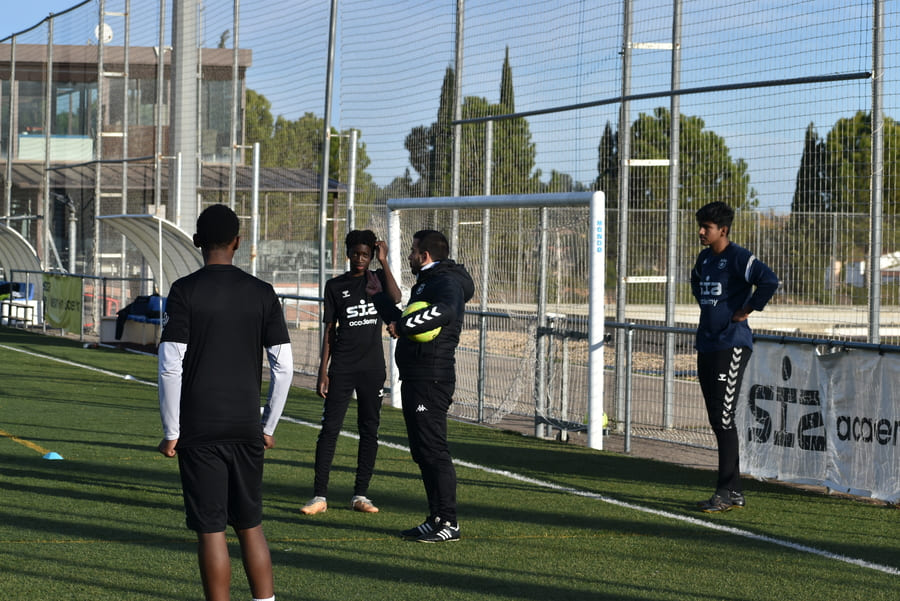
At SIA Academy we understand that the mind must be trained within the real context of the game. That is why we design tasks where decision-making is constant and conditioned by space, time and opposition. We are not looking for memorised responses, but for players capable of adapting.
We work on mentality from an early age, integrating it into every session. Small-sided games, changing rules and unexpected stimuli force players to think while moving. In this way, the mind becomes accustomed to making quick decisions without losing technical precision.
Alain highlights this approach: “when we train the mind together with the body, the player learns to compete, not just to train”. This philosophy guides our daily methodology and defines our educational identity.
Automation and game reading
One of the main objectives of mental training is to automate frequent decisions. When the mind recognises patterns of play, it responds without the need for conscious analysis. This frees up cognitive resources and allows anticipation of the action.
Variable repetition is key in this process. Exposing mentality to multiple similar, but never identical, scenarios improves adaptability. The player does not repeat actions, they interpret situations, which raises performance in unpredictable contexts.
Long-term benefits for the footballer
Training mentality not only improves immediate performance, but also has a lasting impact on a player’s career. In the long term, greater tactical intelligence, better emotional management and more mature decision-making are developed.
In addition, a trained mind reduces competitive stress and increases confidence in play. The footballer feels prepared to take responsibility and lead on the pitch. Mental security translates into consistency and regularity, two essential qualities at the highest level.
A real competitive advantage
In a football world that is increasingly physically balanced, the mind makes the difference. Players who decide faster and better arrive earlier to the action, optimise their efforts and understand the game more deeply.
At SIA Academy we are committed to developing complete footballers, capable of thinking, feeling and deciding on the pitch. Training the mind is not an add-on, it is a necessity. When the player learns to trust their mentality, the game flows and performance multiplies.