



In modern football, where details make the difference, individual development has become a decisive factor in the training of young players. Collective training sessions remain essential, but more and more families understand that the real leap in quality comes when the footballer works individually on weaknesses and enhances strengths. This personalized dedication not only improves performance, but also builds confidence, autonomy, and discipline.
At SIA Academy we firmly believe that every child has their own path. That is why, within our 2026 summer camp — which will take place from June 22 to August 15 — we promote an approach where individual work complements group learning. It is not about replacing the team, but about better preparing the player to contribute more when returning to it.
Table of contents
Why individual work makes the difference
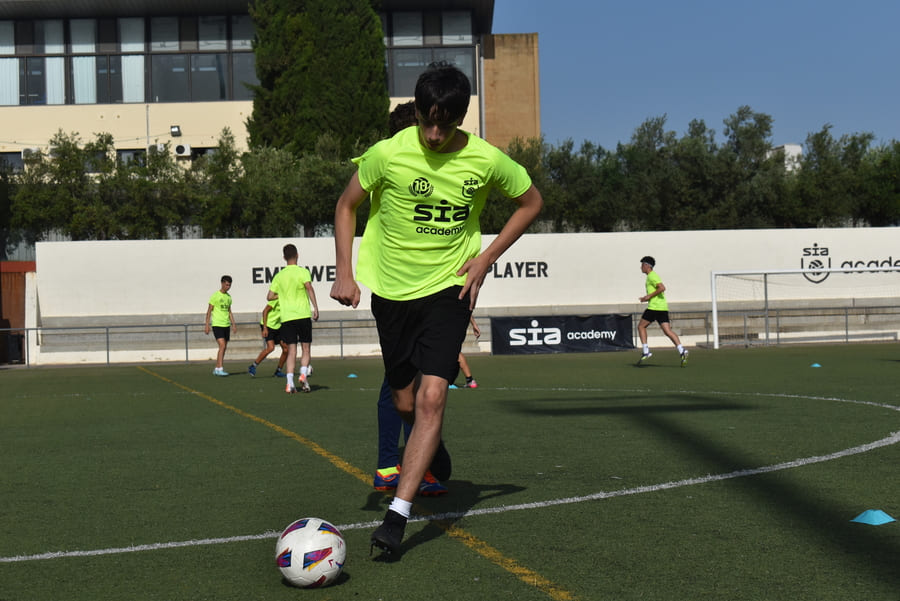
Individual training allows focus on specific technical aspects: control, striking, body positioning, coordination, or decision-making. In collective training, intervention time per player is limited; in contrast, individual work multiplies repetitions and accelerates assimilation.
Moreover, this type of preparation develops personal responsibility. The child understands that progress largely depends on daily involvement. They learn to train even when no one is watching, a quality shared by elite footballers.
Alain, a coach at the academy, summarizes it this way: “Talent opens doors, but the habit of individual work is what keeps you inside.” This idea reflects a reality observable in high-level youth football.
Physical, technical, and mental benefits
The impact of individual work is not only technical. It also influences physical and psychological preparation. Personalized exercises can be adapted to the player’s biological age, preventing injuries and correcting muscular imbalances.
From a mental perspective, individual training strengthens concentration and resilience. When a child repeats a movement until mastering it, they experience a sense of achievement that reinforces intrinsic motivation. They do not depend solely on external recognition, but on their own self-improvement.
At our summer camp we work so that each participant receives specific guidance that can be applied beyond the weeks of coexistence. Our goal is not only for them to enjoy the summer, but to leave with clear tools to progress throughout the entire season thanks to a methodology that prioritizes individual growth.
The role of the family in this process
Parents play a fundamental role. Providing spaces and time for training at home or in the park can make a significant difference in the medium term. It is not about pressure, but about support and normalizing daily effort.
Small routines — daily touches, coordination exercises, visualization of plays — create a culture of constant improvement. When the child perceives support without excessive demands, learning flows naturally and individual progress becomes sustainable.
Alain also notes: “Many young players improve more in 20 minutes of conscious individual work than in two hours of distracted training.” This statement highlights the importance of quality over quantity and reinforces the need to integrate the individual habit into the weekly routine.
How we apply it in our summer camp
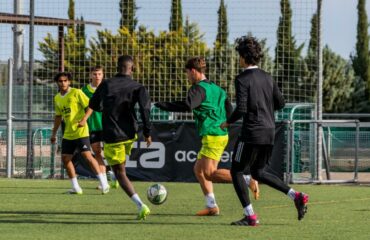
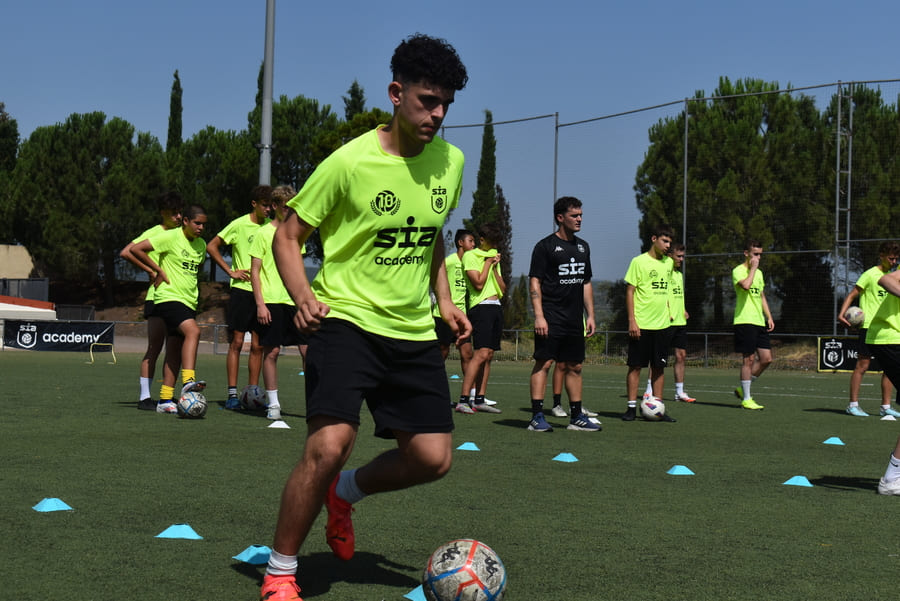
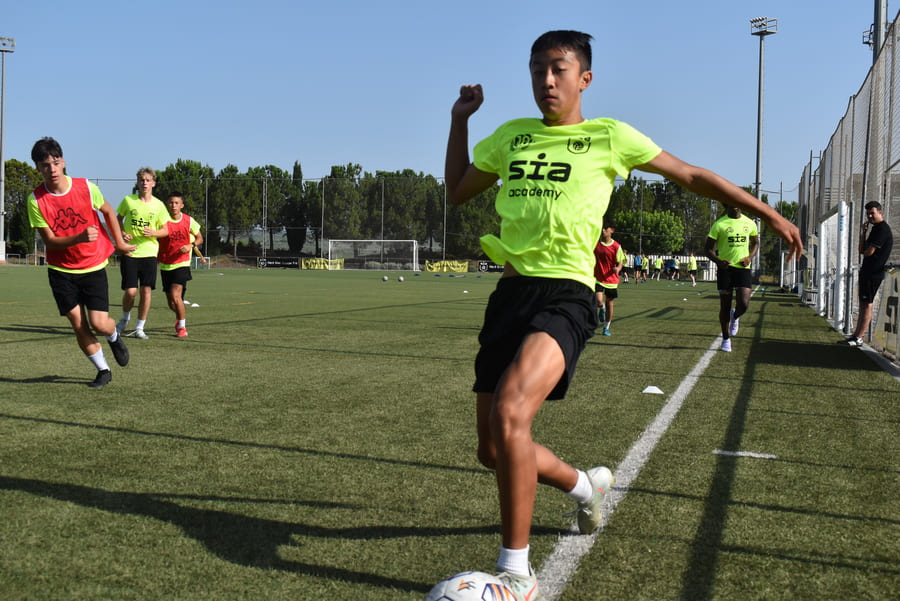
During the 2026 summer camp, we structure the day to combine collective sessions with specific blocks of guided individual work. We analyze each player’s characteristics and propose tasks adapted to position, level, and objectives.
For example, a forward may focus on finishing and off-the-ball movement, while a defender works on positioning, anticipation, and build-up play. This personalization allows everyone to progress, regardless of their starting point and respecting their individual learning pace.
In addition, we promote self-evaluation. Players learn to identify what they need to improve and how to do it — a key skill for any sporting career. Individual training stops being an external obligation and becomes a personal tool integrated into their competitive mindset.
Our camp, active from June 22 to August 15, 2026, offers a professional, international, and demanding environment where each child can experience real growth. At SIA Academy we support that process with closeness, experience, and structured planning.
Preparing the footballer of the future
Football is evolving toward increasingly complete profiles. It is no longer enough to be good at just one aspect. The modern player must master technique, tactics, physical condition, and mindset. Individual work is the only path to achieving that level of completeness and differentiation.
In our methodology we understand that development does not compete with collective play — it enhances it. A player who improves individually brings more solutions to the team and makes decisions with greater confidence.
Investing in this type of training not only increases the chances of sporting success, but also strengthens confidence, autonomy, and discipline that will accompany your child throughout life. Because, in the end, great teams are built with players capable of growing on their own.
And that growth begins when the ball rolls alone, when effort is constant, and when commitment becomes truly individual.