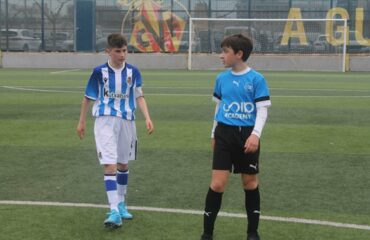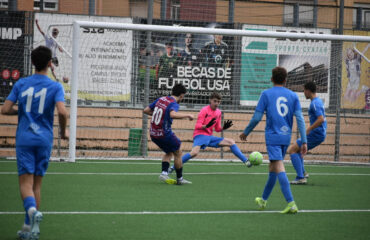




Modern football demands players capable of responding effectively in unstable, changing and highly unpredictable contexts. It is no longer enough to train physical capacities in isolation, because in real play everything happens at the same time. The player runs, loses balance, observes, interprets and decides within fractions of a second, which forces a rethinking of how exercises are structured.
In this context, exercises that integrate balance, agility and decision-making have become a key tool for reproducing real match situations. These tasks allow the body and mind to work together, promoting deeper learning that is more transferable to competition.
Table of contents
Exercises as the functional foundation of performance
Balance is the starting point of any effective action in football. Every jump, change of direction or strike is performed from a base that is rarely stable. Exercises aimed at challenging postural control help players maintain technical quality even under contact or after being thrown off balance by an opponent.
When balance is trained in an integrated way, the footballer learns to stabilise the body without consciously thinking about it. Stability becomes automatic, allowing attention to focus on the ball, teammates and available space. This type of exercises generates adaptations that are much closer to the real demands of the game.

Agility with tactical intention
Agility is not just about moving fast, but about doing so with a clear purpose. Braking, accelerating or turning only makes sense when it responds to a correct reading of the environment. Exercises that incorporate variable stimuli force the player to react and adjust movement based on the information received.
At SIA Academy we work on this concept from a global perspective. We design exercises where agility is linked to the tactical context, including the ball, teammates and progressive opposition. We understand that moving fast without thinking does not prepare the player to compete, so every movement must have a football-related reason.
Decision-making under physical pressure
One of the greatest challenges in modern football is making the right decisions when the body is fatigued or unbalanced. Exercises that combine physical and cognitive demands force players to choose the best option in limiting situations, similar to those that occur during a match.
According to Ximo, the academy’s physical trainer, “when the player makes decisions while the body is in an unstable situation, we are training exactly what happens in competition”. This approach turns each task into a real learning opportunity.
In addition, variability is a determining factor. Repeating the same pattern over and over reduces the capacity to adapt. That is why exercises must be constantly modified in space, time and rules, keeping the footballer in a continuous state of attention and adjustment.

Our integrated methodology
At SIA Academy we understand training as a process that is coherent with the game. We focus on exercises that integrate physical, technical and cognitive aspects into a single action, avoiding decontextualised tasks. We aim for the player to learn how to solve problems, not just execute movements.
Our methodology is based on well-structured progressions. We start with exercises of lower complexity and gradually add uncertainty, respecting learning processes. Ximo sums it up clearly: “we are not looking to tire the player, we are looking for every action to make sense within the game”.
Short- and long-term benefits
The systematic application of integrated exercises improves coordination, movement efficiency and concentration capacity. In the short term, the player feels more confident in situations of imbalance. In the long term, they develop better game reading and greater autonomy in decision-making.
In addition, this type of exercises contributes to injury prevention, as it prepares the footballer to respond effectively to unexpected situations. The body learns to adapt, and the mind to anticipate.
In short, exercises that combine balance, agility and decision-making in a single movement are not a trend, but a necessity in modern football. Integrating them coherently allows for the development of more complete, intelligent players who are better prepared to compete at the highest level, exactly as we work day by day at SIA Academy.