




At SIA Academy we have always believed that the true improvement of a footballer cannot be evaluated only with feelings or isolated results. For us, evolution must be measured with objective data, with clear metrics, and with constant monitoring that allows us to understand how each player progresses in their development process. Over the years we have developed our own system based on seven internal metrics that help us analyse performance from several perspectives, always with a holistic vision of the footballer.
Índice
1. Decision-making speed
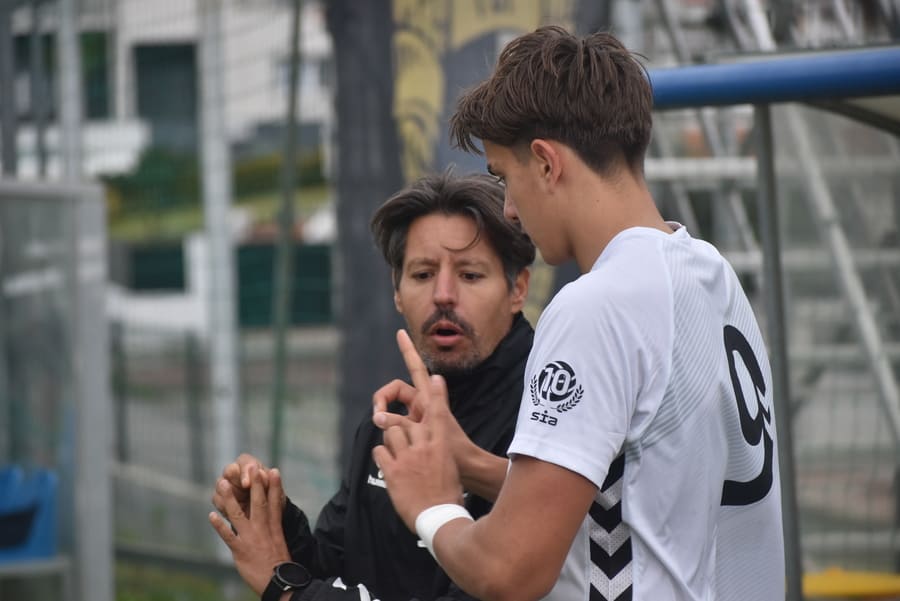
The first that we analyse is how quickly the player interprets situations and acts accordingly. It is not only about running fast, but about thinking fast. For us, this metric is essential because it reflects the level of game understanding. As Alain, one of our academy coaches, says: “An intelligent player saves energy, solves situations earlier, and makes a difference even without touching the ball.” This metric allows us to detect cognitive progress, which we consider a key pillar.
2. Technical quality under pressure
Measuring isolated technique is useful, but not enough. That is why we evaluate a more complete metric: technical performance when the player is under real pressure, whether from opponents, game rhythm, or reduced spaces. We analyse actions such as controls, passes, dribbles or finishes in demanding situations. When this indicator improves, we know the player is evolving towards true competitive football.
3. Effort efficiency
In our methodology we give great importance to how the player manages their energy during a match. We use statistics that compares the effort made with the productivity obtained: useful runs, relevant sprints and decisive actions. This indicator helps us avoid unnecessary fatigue and enhance movements that truly impact the game.
4. Real tactical influence
It is not enough for a player to know the theory; they must apply it coherently on the field. That is why one of our internal metrics evaluates the ability to maintain the team’s tactical structure, interpret spaces, anticipate plays and adapt to different contexts. Alain explains it very well: “Talent without order is noise; the tactically ordered player turns that talent into an advantage.” This metric is one of the most decisive in our weekly analysis.
5. Consistency in performance
The fifth indicator measures the player’s ability to maintain a stable level over several sessions and matches. For us, consistency is worth more than a brilliant but isolated performance. This metric allows us to see whether the player is following an upward trend or needs support in specific training aspects. Real progress is only proven when this indicator improves consistently.
6. Emotional and mental impact
The sixth metric focuses on behaviour: resilience, concentration, error management and competitive mentality. At SIA Academy we understand that football is also a mental sport, and that is why this emotional metric is as relevant as the physical or technical ones. The player who shows mental maturity accelerates their learning, improves decision-making and stays calm in key moments.
7. Adaptability to competitive rhythm
The final metric brings together several parameters: execution speed, sustained intensity, tolerance to physical contact and response to quick transitions. We consider this metric a synthesis of all the previous ones, because it reflects how the player adapts to the rhythm of real football. When progress becomes evident in this metric, we know the player is ready to compete at a higher level.
Why these metrics transform us as an academy
At SIA Academy we do not aim to create players who stand out only in training; we aim to form footballers who understand, execute and compete with coherence. Our internal metrics allow us to see not only where each player stands today, but where they can go. This system, which we have refined season after season, is an essential part of our identity.
Each metric we use has a purpose. Each analysis reinforces our commitment to real development. And each improvement confirms that daily work has a direct impact on the player’s growth. This is why we always say that in our academy, improvement does not happen by chance: it happens because we measure, understand and act.