




Modern football demands much more than natural talent. Understanding how a player evolves according to their age and stage of development is key to building solid and sustainable sporting careers. Each phase of growth presents different physical, cognitive and emotional needs, and failing to respect them can slow progress or even lead to early dropout from the sport. That is why adapting training is not a trend, but a fundamental pillar of modern development.
Table of contents
Childhood as the foundation of learning
Between the ages of 6 and 10, the main objective is to create a positive relationship with the game. At this early stage, training should focus on motor exploration, coordination and enjoyment. Children learn best when they feel free to experiment, make mistakes and try again without external pressure. The ball becomes an element of play, not a tool of demand.
Forcing rigid structures or competitive results at young ages often leads to demotivation. “If a player does not enjoy the game in their early years, it is very difficult for them to maintain enthusiasm later on”, explains Frederico Pereira, sporting director of the academy. Therefore, creativity and spontaneity must play a central role in the development process.
Preadolescence and the building of habits
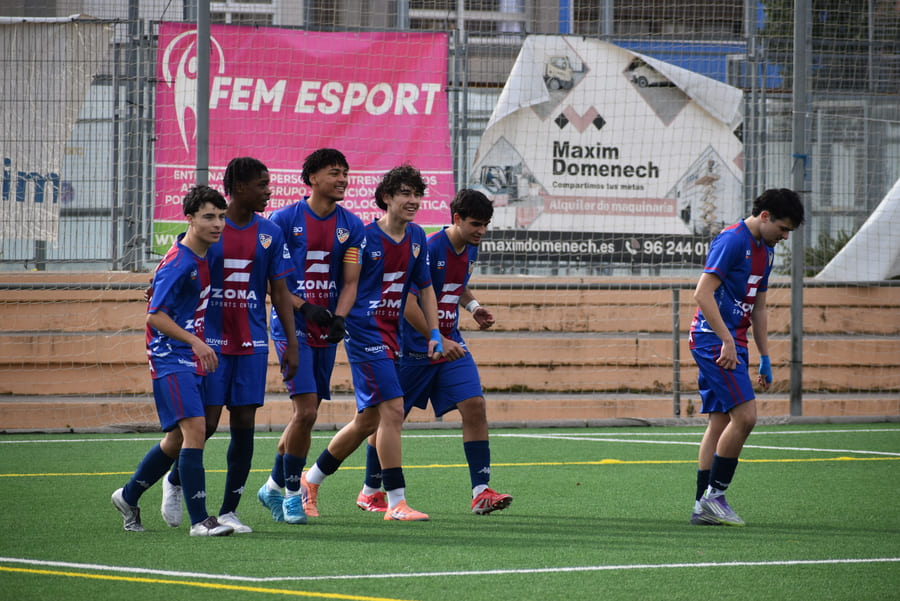
Between the ages of 11 and 13, a key transitional stage begins. The player starts to better understand rules, space and their role within the team, which allows for greater organization in training. At this point, technical fundamentals are reinforced, discipline habits are developed and individual responsibility is encouraged, always adapting to different rates of maturation.
It is essential to understand that not all footballers grow at the same pace. Comparing performances or demanding uniform physical responses can be harmful. At this stage, educational support is just as important as the work done on the pitch.
Adolescence and competitive development
Between the ages of 14 and 17, training becomes more complex from both a tactical and physical perspective. The body changes rapidly and the mind begins to take on more demanding competitive challenges. Performance pressure, self-criticism and constant comparison emerge as factors that must be carefully managed.
Alongside physical and technical work, the emotional aspect becomes especially relevant. “Talent needs an environment that protects it and challenges it at the same time”, notes Frederico Pereira. Without proper guidance, many players with potential fall by the wayside at this decisive stage.
The post-development stage and specialization
From the age of 18 onwards, the footballer enters a phase of consolidation. Training is adjusted on an individual basis, taking into account the player’s profile, position, history and professional objectives. Performance optimization, injury prevention and mental preparation become clear priorities.
At this point, the player no longer simply carries out tasks, but understands the purpose of each stimulus and takes an active role in their own development. The quality of the process makes the difference between competing at a high level or remaining at an intermediate standard.
Our vision of training at SIA Academy
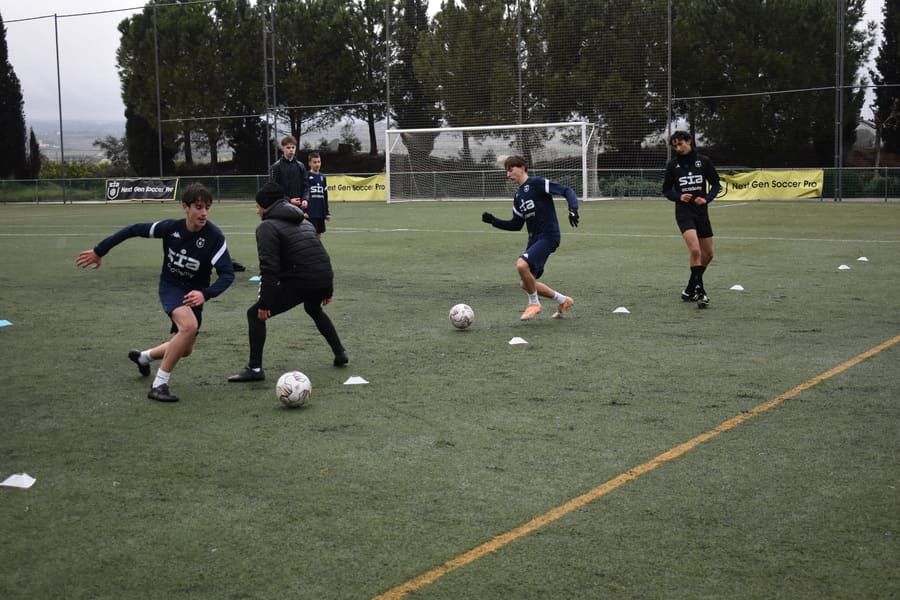
At SIA Academy we understand training as a progressive, coherent and people-centered process. We work with a methodology that respects each stage of development and avoids accelerating processes for short-term interests. Our approach combines sports science, professional football experience and individualized monitoring that allows us to adapt workloads, objectives and expectations.
When we talk about development, we also talk about values, education and context. At SIA Academy we believe that footballers must grow both on and off the pitch, understanding their own process and developing tools that will serve them beyond football.
Developing before demanding
Adapting training to different ages not only improves performance, but also protects the player and enhances long-term development. Respecting timings, understanding the needs of each stage and providing an appropriate environment is the foundation of any serious development project. When the process is right, progress comes naturally and sustainably, allowing talent to flourish at the right moment.