


December 5 marked one of the most anticipated moments on the international football calendar: the World Cup 2026 draw. It was not just another symbolic event, but the exact point at which the tournament began to take on real shape. From that moment on, national teams, coaching staffs, analysts, and fans started to visualize specific opponents, contrasting playing styles, and potential future matchups. The World Cup ceased to be an abstract idea and became a clear roadmap, especially significant as it will be the first edition featuring 48 national teams and a completely renewed format.
Table of contents
A new format that reshapes the group stage
The main structural novelty is the creation of 12 groups of four teams, instead of the traditional eight groups. This change expands global participation and increases stylistic diversity from the opening phase. In such a large World Cup, the group stage takes on enormous strategic importance, as every match becomes decisive in setting the tone for the rest of the tournament.
The draw respected FIFA’s usual continental balance criteria, avoiding early clashes between teams from the same confederation whenever possible. The result is a set of highly diverse groups, combining European, African, American, and Asian teams, and promising very different tactical interpretations.
The World Cup groups, one by one: balance and contrast
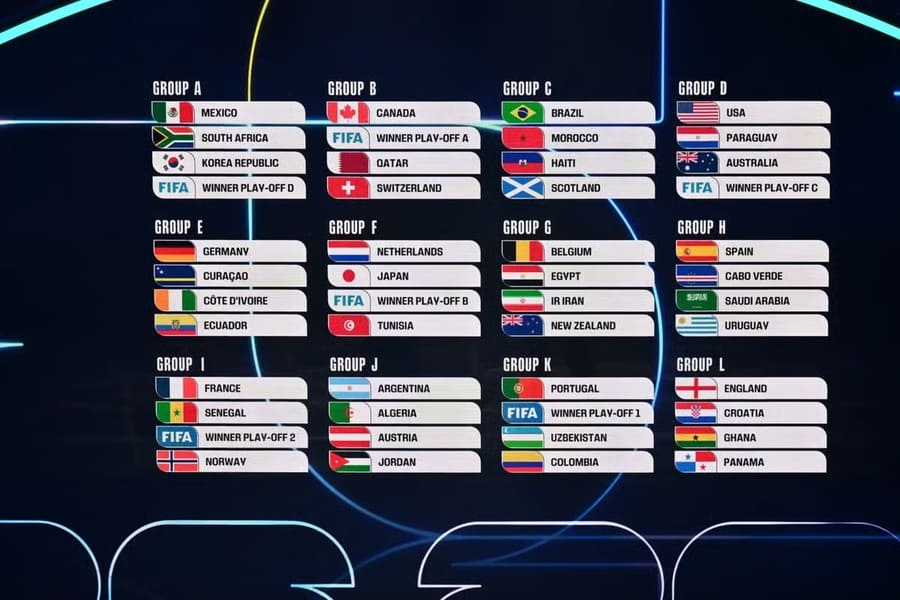
Group A is headed by Mexico, alongside South Korea, South Africa, and a European team coming from the playoffs. It is an open group, where the host nation holds a slight advantage but faces demanding opponents. Group B brings together Canada, Switzerland, Qatar, and another European playoff team, a mix of tactical discipline and physical intensity.
Brazil leads Group C together with Morocco, Scotland, and Haiti, one of the most attractive groups due to its stylistic contrasts. The United States tops Group D along with Paraguay, Australia, and a yet-to-be-determined European side, a scenario where parity could be decisive. Germany, Ecuador, Ivory Coast, and Curaçao make up Group E, with a clear favorite but strong physical challenges.
Group F combines the Netherlands, Japan, Tunisia, and a European playoff team, a clear example of tactical diversity. Belgium, Iran, Egypt, and New Zealand form Group G, a very physical group with high-intensity matches. France leads Group I alongside Senegal, Norway, and a team from the international playoffs, making it one of the most demanding groups.
Argentina heads Group J with Austria, Algeria, and Jordan, while Group K includes Portugal, Colombia, Uzbekistan, and a team coming from international qualification. England, Croatia, Panama, and Ghana complete Group L, another group full of footballing tradition.
This distribution confirms that the World Cup offers no room for complacency, as even the strongest favorites will have to perform from the very first match.
Spain’s group: a detailed analysis of the challenge
Spain was drawn into Group H alongside Uruguay, Saudi Arabia, and Cape Verde. At first glance, the draw offers a favorable scenario, but one full of nuance. Uruguay represents South American tradition and experience, with intense, competitive football and strong mentality. Saudi Arabia, despite lacking the historical weight of other rivals, has shown in recent tournaments that it can surprise through tactical discipline and physical commitment. Cape Verde, less accustomed to this stage, arrives as the group’s theoretical underdog, but with room to grow in a format that allows for greater competitive margin.
In this World Cup, Spain will need to manage not only quality but also match contexts, alternating long periods of ball dominance with phases that require defensive solidity. The key will be to secure qualification without unnecessary complications in order to avoid early clashes with major powers.
The paths already drawn by the knockout bracket
Beyond the group stage, the draw also defined the full tournament bracket. The World Cup begins to be won by correctly interpreting potential matchups, because finishing first or second in the group can make a huge difference in the knockout rounds. For Spain, a strong position in Group H could help avoid early encounters with teams such as France, Brazil, or England.
This reality turns every point into a strategic asset. In a World Cup of this scale, consistency weighs almost as much as individual talent, something coaching staffs are already fully aware of.
A formative and analytical reading of the draw
At SIA Academy, we experience events like this with a perspective that goes beyond immediate results. We analyze the groups as performance environments, shaped by cultural, physical, and tactical factors. The draw allows us to identify trends, anticipate competitive demands, and understand how national teams prepare to face very different opponents within a short time span.
For us, the World Cup is the greatest laboratory of modern football, an ideal context for observing the evolution of playing models, pressure management, and the advanced use of performance analysis. Each group offers valuable lessons for the education of future sports professionals.
A tournament that inspires new generations
The impact of the draw goes far beyond the participating teams. Every World Cup acts as a source of inspiration for young players, coaches, and analysts, who see in this stage the ultimate goal of their development. Understanding how groups are formed, how matches are planned, and how key phases are managed is an essential part of high-level football education.
The real start of the countdown
The World Cup draw held on December 5 marked the true start of the countdown. With the groups defined and the paths outlined, the tournament is now part of the present of international football. The World Cup 2026 is shaping up to be more open, diverse, and demanding than ever, with Spain entering the competition full of ambition and strong competitive arguments.
From now on, every training camp, squad announcement, and friendly match will be influenced by this draw. The World Cup is no longer a distant promise, but a tangible challenge, and world football moves steadily toward its next great event.