






The development of a modern footballer goes far beyond individual technique. Today, understanding the game is just as important as execution. In this context, tactical principles become the foundation on which collective performance is built. Understanding when to attack, how to defend and why to make certain decisions makes the difference in youth and competitive football.
Table of contents
The importance in training
The principles are the unwritten rules that guide players’ behavior during the match. It is not about rigid movements, but about ideas that guide decision-making. A footballer who understands the principles of the game is able to adapt to any system, opponent or situation.
In our sessions, we prioritize understanding over memorization. We want players to understand the “why” of each action. The principles allow the team to function as a unit, maintaining order both in attack and defense.
“When a player understands the game, they stop reacting and start anticipating,” says Alain, academy coach.
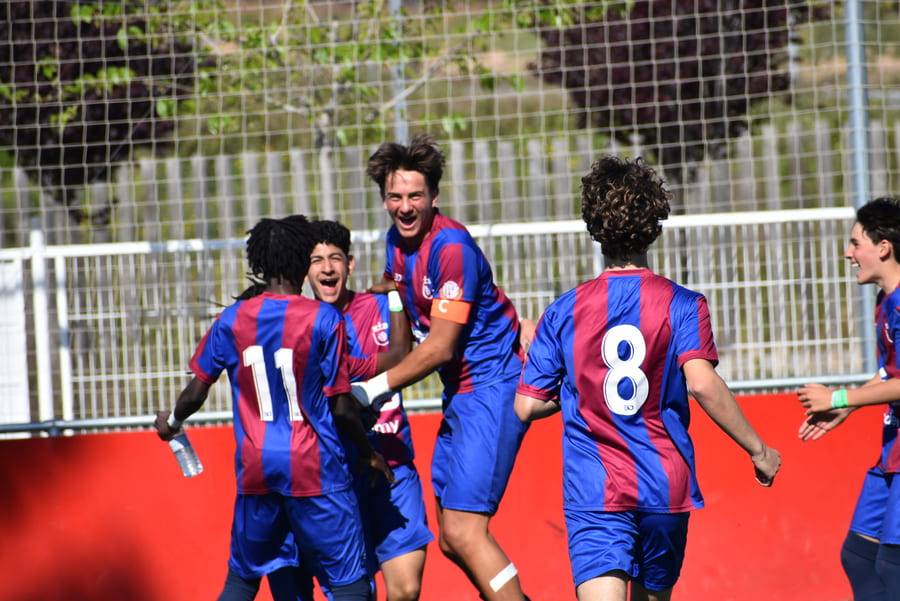
Principles offensive in the modern game
In the offensive phase, the main objective is to generate advantages over the opponent. For this, there are several key concepts that must be worked on consistently. Among them stand out width, depth, mobility and rational occupation of spaces.
Width opens the field and makes defensive organization more difficult. Depth aims to attack spaces behind the defense. Mobility generates constant passing lanes, while space occupation ensures balance in attack. Applying these offensive concepts correctly allows more chances and improves the fluidity of the game.
At SIA Academy we design exercises where these ideas appear naturally. It is not about isolated actions, but real situations where the player must interpret the context. Contextual learning facilitates transfer to the match.
Key defensive principles
In defense, the objective changes: to prevent the opponent from progressing and recover the ball. Here concepts such as pressing, covering, balance and concentration come into play. Each one plays a specific role within the defensive system.
Pressing aims to reduce the opponent’s time and space. Covering protects the teammate who is pressing. Balance ensures the team is not disorganized, and concentration avoids mistakes at key moments. Mastering these defensive fundamentals is essential to build solid and competitive teams.
From our experience at SIA Academy, we work on these aspects progressively. We adapt exercises to the age and level of the player to ensure proper assimilation. Defense is not only effort, but also tactical intelligence.
“Defending well is not running more, it is thinking better,” explains Alain.
The connection between attack and defense
One of the most important aspects in modern football is the transition between phases. These ideas should not be understood in isolation, but as an interconnected system. The speed at which a team switches from attack to defense, and vice versa, defines its competitive level.
When possession is lost, actions such as counter-pressing or dropping back come into play. When possession is regained, concepts such as fast build-up or offensive reorganization appear. Training these transitions allows players to adapt to changing match situations.
At SIA Academy we give special importance to these phases of the game. We design tasks where transitions are constant, forcing players to think and react quickly.

Methodology applied to learning
The way these concepts are taught is as important as the concepts themselves. It is not enough to explain them; it is necessary to experience them on the pitch. That is why we rely on active methodologies where the player is the protagonist.
We use small-sided games, real situations and contextual corrections. This approach allows learning to be meaningful and long-lasting. The player not only understands the concepts, but applies them naturally.
In addition, we encourage communication within the team. Players must be able to organize and support each other based on what is being worked on. Football is a collective sport, and shared understanding improves overall performance.
Impact of principles on player development
Working on these concepts from the base has a direct impact on a player’s evolution. It not only improves current performance but also prepares them for higher levels. A player trained with this vision has more tools to adapt to any competitive context.
At SIA Academy we have seen how this approach transforms players. Those who understand the game make better decisions, commit fewer mistakes and have greater confidence on the pitch.
Offensive and defensive concepts are the foundation of modern football. Their teaching must be a priority in any academy that aims to develop complete players. It is not just about playing well, but about deeply understanding the game.
From our experience at SIA Academy, we commit to a model where tactical knowledge and practice go hand in hand. Forming intelligent players is the true goal of youth football development.