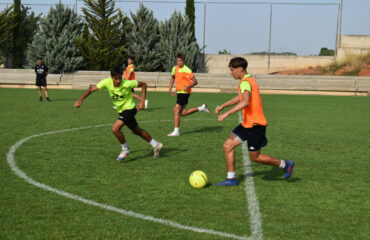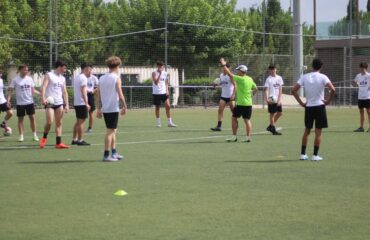





In modern football, where the speed of the game increases every season, coordination has become an essential pillar of performance. It is not enough to run fast or be strong: the player must be able to synchronize movements, perceive the environment, and execute precise actions in milliseconds. This ability determines whether a touch is clean, whether a change of direction is effective, or whether a shot is delivered with balance.
At SIA Academy we understand that coordination is the bridge between physical capacities and technical skills. That is why, within our training methodology, we devote special attention to its development from an early age. It is not only about improving current performance, but about building a solid foundation for the player’s sporting future.
Table of contents
Beyond technique and strength
Many parents associate football progress with improving striking ability or endurance, but coordination is what allows those qualities to be expressed effectively. A footballer may have power, but without coordination their movements will be disorganized and less efficient.
Moreover, this ability directly influences injury prevention. When the body responds harmoniously, the joints suffer less stress and technical gestures are executed more safely. A coordinated player not only performs better, but also protects themselves without even realizing it.
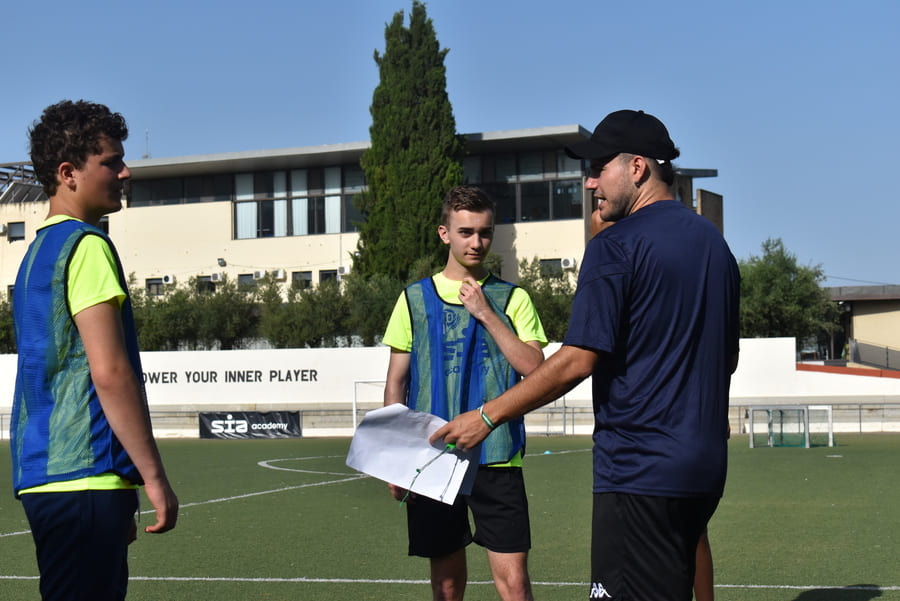
Ximo, the academy’s fitness coach, summarizes it this way: “Coordination is the invisible foundation of performance; when it is missing, everything else loses quality.” His experience working with young talents confirms that many technical limitations originate from coordinative deficits.
Development from an early age
Childhood is the ideal time to enhance coordination. The nervous system is in full maturation and quickly assimilates varied stimuli. Jumps, turns, changes of pace, or exercises with the ball help create a broad motor repertoire that will be decisive in later stages.
In our sessions we prioritize dynamic and playful tasks that stimulate coordination without falling into monotony. Learning occurs almost without the player being aware of it, through play and constant challenge. This way of working keeps motivation high and encourages repetition of complex movements.
The goal is not to form premature specialists, but complete athletes capable of adapting to any game situation. Coordination acts as a transversal tool that enhances all other capacities.
Impact on decision-making
Football is not only physical; it is also perceptual and cognitive. Coordination allows the integration of visual information with the appropriate motor response. A through pass, a dribble, or a defensive cover all depend on that connection between mind and body.
When this ability is well developed, the player seems to have more time to act. In reality, what happens is that their neuromuscular system processes and executes more efficiently. Coordination turns speed into precision and intuition into effectiveness.
Ximo explains it clearly: “A coordinated footballer not only moves better, but thinks better because their body responds exactly as expected.” This synchrony generates confidence and reduces uncertainty in pressure situations.
How we apply coordination in our methodology
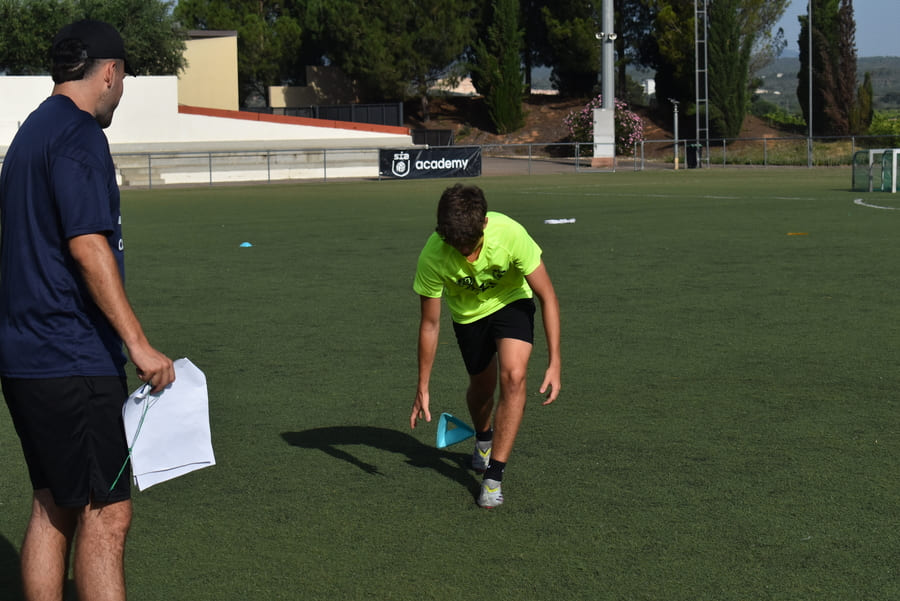
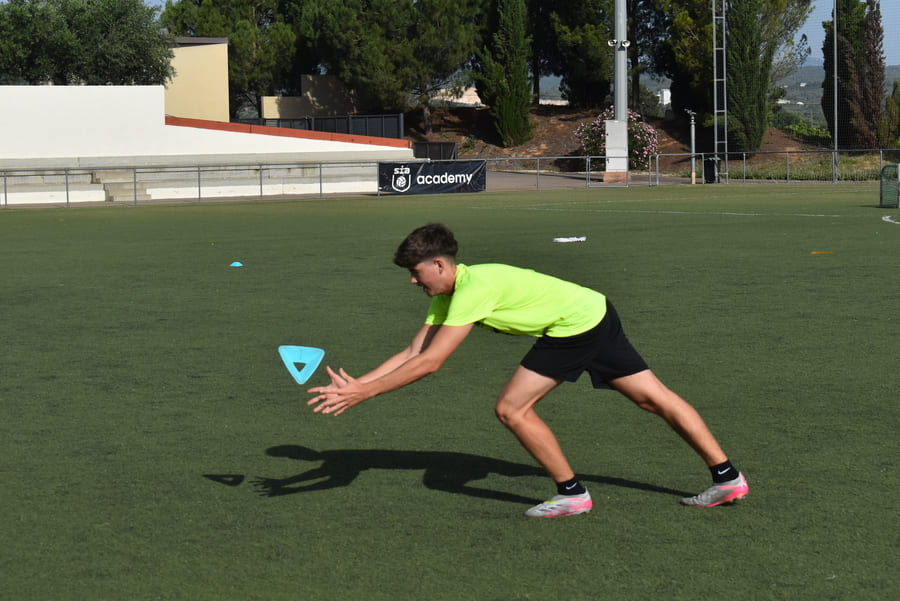
At SIA Academy we integrate specific coordination exercises into all phases of training. We use circuits, agility ladders, ball tasks, and real opposition situations so that transfer to the game is direct.
We do not seek aesthetic movements, but functional ones. Each task is designed to reproduce real football demands: sudden stops, unexpected turns, jumps, receptions in imbalance, or changes of direction. The objective is for the player to develop resources for any competitive scenario.
In addition, we adapt the loads according to age and level. A child in the formative stage needs different stimuli from an adolescent in the performance phase. This individualization guarantees safe and continuous progress.
Long-term benefits
Systematic work on coordination generates effects that go beyond the pitch. It improves posture, balance, laterality, and body awareness. These qualities influence even everyday life, from practicing other sports to preventing falls.
In football terms, a player with good coordination learns new skills more quickly. Their body has a broader and more adaptable “motor language.” This accelerates technical learning and facilitates tactical evolution as the competitive level increases.
Furthermore, coordination contributes to energy efficiency. More fluid movements imply lower physical expenditure, allowing intensity to be maintained for longer and recovery between actions to be improved.
Preparing the complete footballer
Modern football demands versatile profiles capable of performing in tight spaces and at high speed. Coordination is the foundation that allows technique, physical condition, and decision-making to combine into a single effective action.
At our academy we are committed to developing complete players, not just specialists in one specific skill. We understand that true performance arises from the harmonious interaction of all capacities. When coordination is present, talent expresses itself naturally and consistently.