




Football, although it may seem like a chaotic and emotional sport at first glance, is deeply influenced by mathematical principles. Among them, geometry plays a key role in positioning, space occupation, and decision-making. Understanding how angles are created and used on the field can make the difference between a failed play and a decisive action.
Geometry is not only present in tactical systems, but also in every pass, every run, and every off-the-ball movement. Players who master these concepts have a clear competitive advantage, as they are able to interpret the game more efficiently and anticipate what will happen.
Table of contents
How geometry influences positioning
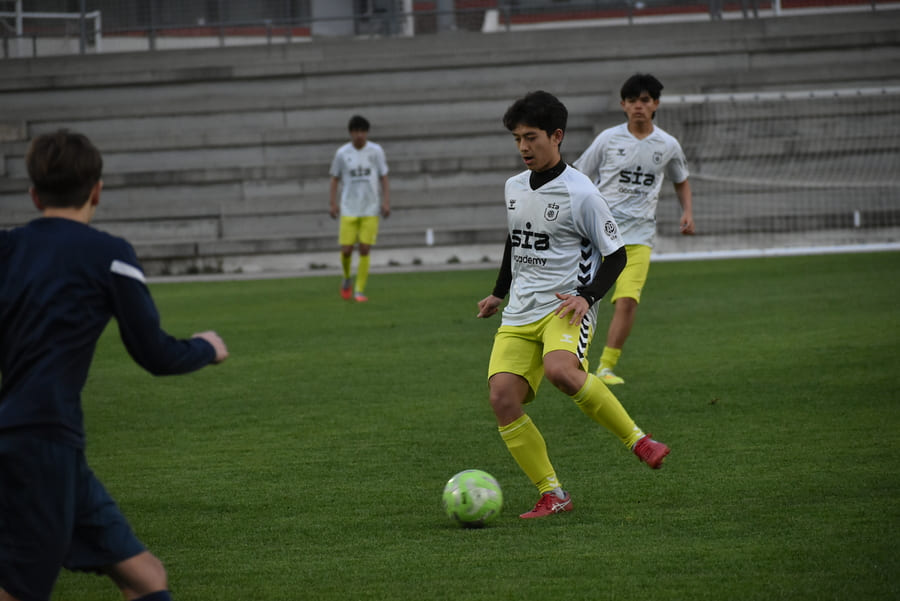
Positioning in football is directly related to the geometry of the field and the players. Every team seeks to create structures that maximize passing lanes and minimize the opponent’s options. Forming triangles and diamonds is one of the fundamental bases of positional play, as it facilitates ball circulation.
When a player positions themselves correctly, they are creating angles that allow the ball to move more quickly. Geometry helps players understand where to stand to always offer a clear passing option. Good positioning is not a coincidence, but the result of advanced spatial understanding.
Additionally, rational space occupation allows the team to maintain balance between attack and defense. Geometry applied to positioning avoids unnecessary player congestion and promotes width and depth.
Angles in the game: key to beating opponents
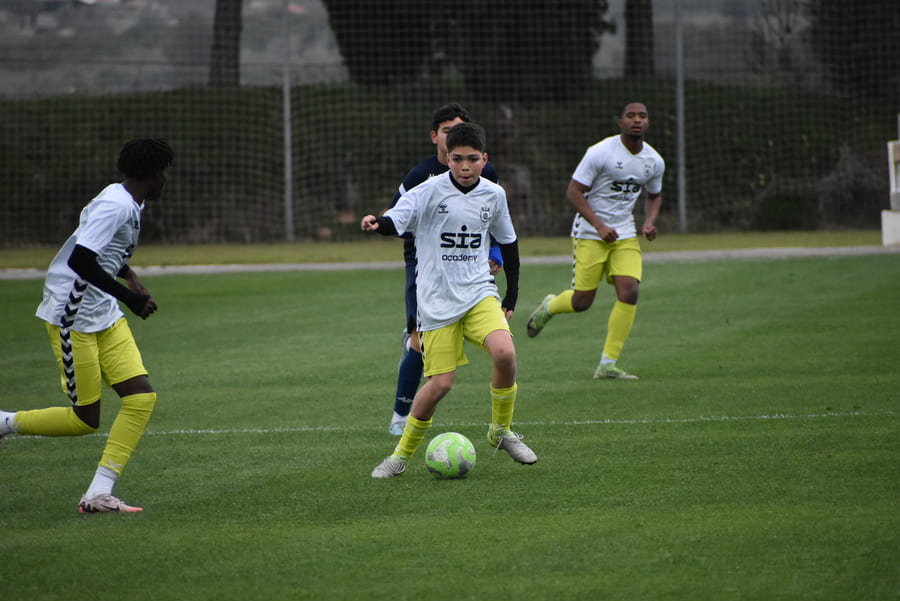
Angles are essential to progress on the field. Every pass involves a geometric calculation, even if it is unconscious. Opening the right angle can break an entire defensive line, while a poor angle can make it easier for the opponent to regain possession.
A diagonal movement, for example, creates more options than a straight one. Players who understand how to modify angles can destabilize any defensive system.
In attacking situations, creating numerical superiority largely depends on the correct use of space and angles. Geometry allows players to identify where the advantage lies and how to exploit it effectively.
Decision-making from a geometric perspective
Decision-making in football happens in a matter of seconds. In that time, the player must analyze multiple variables: teammates, opponents, space, and time. Geometry acts as an internal guide that facilitates this process.
Choosing between passing, dribbling, or shooting often depends on the available angles. A horizontal pass may be safe, but a diagonal one can be more effective if it breaks lines. Geometry helps evaluate these options quickly.
Additionally, in defense, closing angles is fundamental. Reducing the opponent’s options means understanding how to position oneself to limit their possibilities. Defensive geometry is just as important as offensive geometry, as it conditions the opponent’s decisions.
The role of SIA Academy in teaching positioning
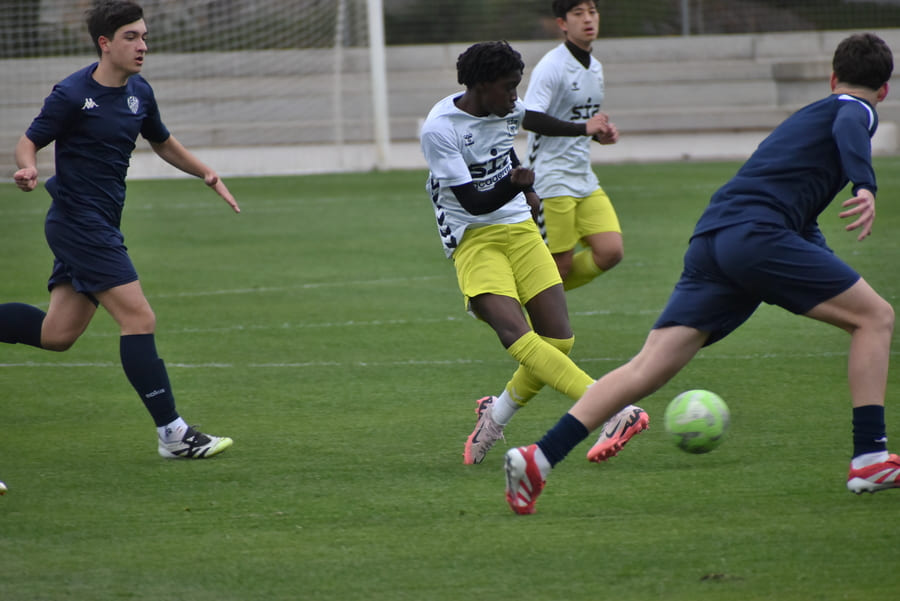
At SIA Academy, we work on geometry as a central element in the development of our players. We understand that talent must be accompanied by tactical intelligence, and this is built through the understanding of space and angles.
We integrate it into our training sessions through specific exercises that simulate real match situations. We use tasks where players must constantly identify and create passing lanes, fostering a more advanced understanding of the game.
As José Luis, academy coach, points out: “When a player understands the geometry of the game, they begin to see solutions where they previously only saw problems”. This vision reflects our methodology, based on conscious learning.
We also work with video analysis to reinforce these concepts. We analyze real plays where geometry has been decisive, allowing players to internalize these patterns.
José Luis also adds: “Geometry is not only taught through theory, it is trained in every action on the field”. That is why at SIA Academy we aim for our players to experience these concepts in every session.
Exercises to improve geometric understanding
There are many exercises that help develop an understanding of positioning in football. One of the most effective is the rondo, where players must constantly move to create passing lanes. This type of exercise forces players to think about angles continuously.
Another useful exercise is positional play in reduced spaces. Here, geometry becomes even more important, as the margin for error is smaller. Players learn to optimize every movement and every pass.
Specific situations can also be trained, such as build-up play or finishing, where geometry determines the success of the action. Repeating these situations helps automate correct decisions.
Geometry is an invisible but decisive component in football. It influences positioning, passing angles, and decision-making. Mastering these concepts allows players to interpret the game with greater clarity and efficiency.
At SIA Academy, we are committed to a comprehensive development model where geometry plays a key role. Through specific training and innovative methodologies, we help our players understand the game from a deeper perspective. Because in modern football, thinking better means playing better.