




In the collective imagination, football is defined by spectacular goals, impossible dribbles, and brilliant assists. However, the true architecture of the game is built away from the ball. Every off-the-ball run, every cover, and every support movement forms an invisible network that sustains collective performance. Elite football is often decided by actions that the casual spectator barely notices.
Playing without the ball requires tactical intelligence, sacrifice, and a deep understanding of the game. There is no immediate applause or viral replays, but there is a direct influence on the result. In modern football, where space and time are increasingly limited, mastering these actions makes the difference between a solid player and a truly decisive one.
Table of contents
Spatial intelligence: occupying the right place
One of the foundations of football without the ball is the rational occupation of space. It is not about running aimlessly, but about appearing where the team needs you at every moment. Knowing when to come closer to offer support or when to move away to stretch the opponent is a less visible form of talent, but absolutely decisive.
Positional midfielders are masters of this art. Their influence is not measured by traditional statistics, but by the stability they bring to the system. They maintain passing lines, balance the team, and allow others to shine. Without that silent structure, attacking football loses fluency and defensive football becomes vulnerable.
At SIA Academy we work on this concept from an early age because we understand that football is not only technique with the ball, but also game reading. We teach our players to scan their surroundings before receiving and to interpret where they will generate the greatest collective advantage.
Off-the-ball runs: creating options where none exist
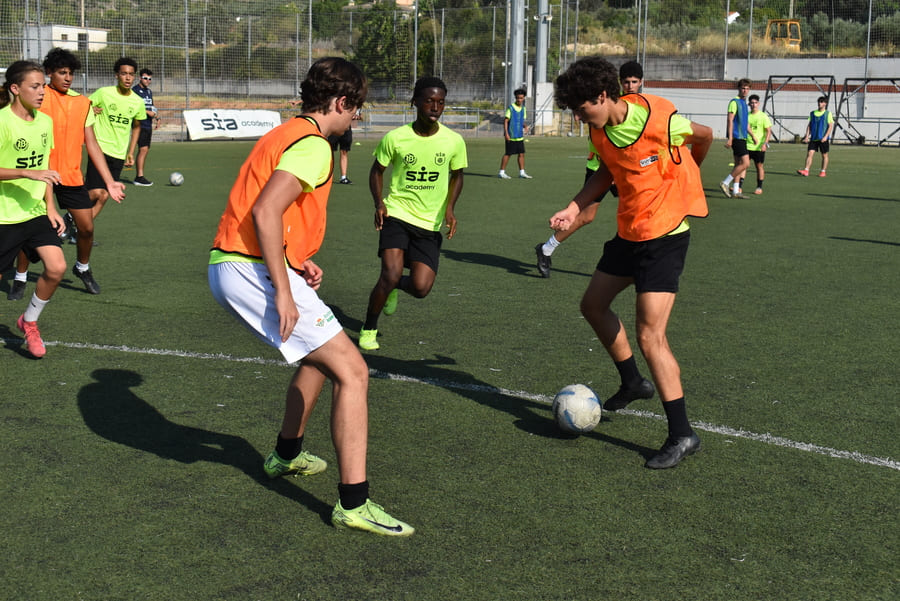
The off-the-ball run is probably the most well-known action without possession, but also one of the most poorly executed in youth categories. Many young players run toward the ball instead of moving away from it to open space. A good run does not always aim to receive, but to disorganize the opposing defense.
There are multiple types: support runs, runs in behind, diagonals, dragging movements… Each responds to a specific tactical intention within football. Top-level forwards master timing: they start just before the pass, not after, gaining decisive meters.
Moreover, constant movement mentally exhausts defenders. Even if it does not immediately lead to a chance, it conditions their positioning and opens opportunities for teammates. It is silent work that rarely appears in football highlights, yet decides matches.
Pressing and recovery after loss
Another crucial dimension of off-the-ball play is the collective defensive phase. When possession is lost, a race against time begins to prevent the opponent’s transition. Coordinated pressing can recover the ball in seconds or at least force the opponent to play long and without control.
Modern football highly values players who work without the ball in defense. Offensive talent alone is not enough; tactical and physical commitment is required. Wingers press fullbacks, strikers guide the opponent’s buildup, and midfielders close passing lanes.
In our methodology at SIA Academy, we insist that defending starts from the front. We develop players who understand football as a permanent collective effort, not as a sequence of individual actions.
Dragging movements and space creation
Some actions do not seek direct protagonism, but to enable others. An attacker who drags two defenders toward one flank frees the central lane for a teammate. These altruistic movements are the essence of collective play and a sign of football maturity.
Many attacking systems are based precisely on these coordinated rotations. Positional football, for example, uses intelligent occupation of lanes and heights to manipulate the opponent. Every off-the-ball movement has a strategic intention.
At SIA Academy we teach players to interpret these dynamics through specific tasks where success does not depend on who scores, but on how the advantage is created. We want our players to understand football as a game of relationships, not isolated actions.
Silent communication in football
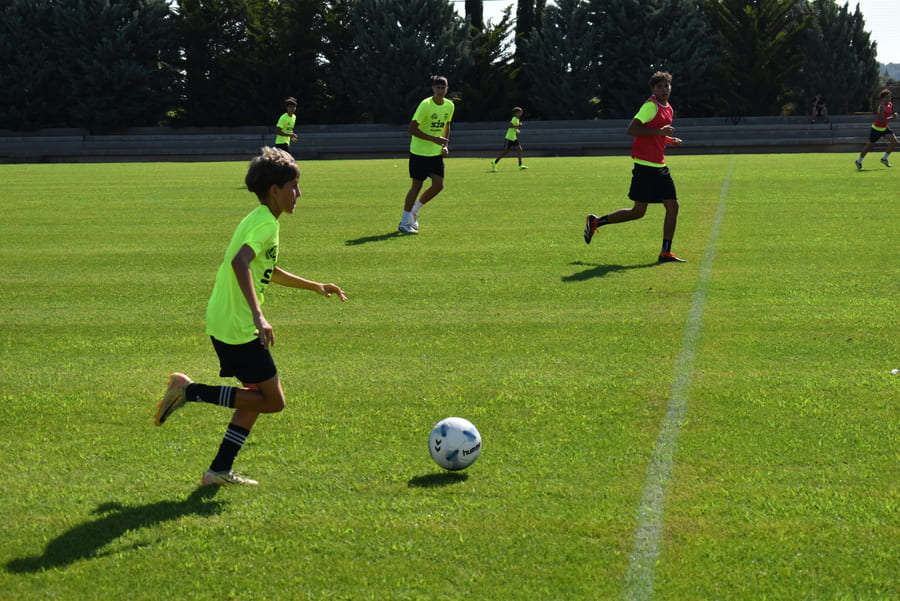
Although football appears noisy, much of the communication on the field is nonverbal. Gestures, eye contact, and timing synchronization replace words. A well-trained team moves like a single organism, anticipating teammates’ decisions.
This coordination is built through hours of joint training and a shared understanding of the game model. When everyone interprets the same signals, off-the-ball movements become automatic and effective.
The invisible that decides the visible
Paradoxically, the moments that define a match often originate from actions no one remembers. A goal may stem from a run that dragged a defender thirty seconds earlier or from a press that forced an error. The final spectacle is only the tip of the iceberg of invisible collective work.
Learning to play without the ball means accepting that individual protagonism serves the team. It means understanding that football is a cooperative sport where every movement influences the others.
Ultimately, mastering this art separates players who participate from those who transform the game. Because, even if they do not appear in highlights, these actions are what allow football to reach its highest tactical and collective expression.