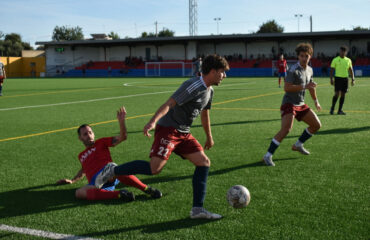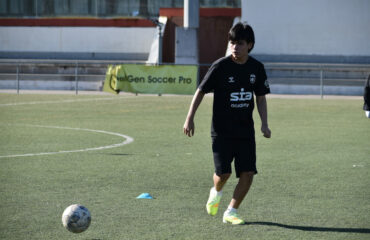



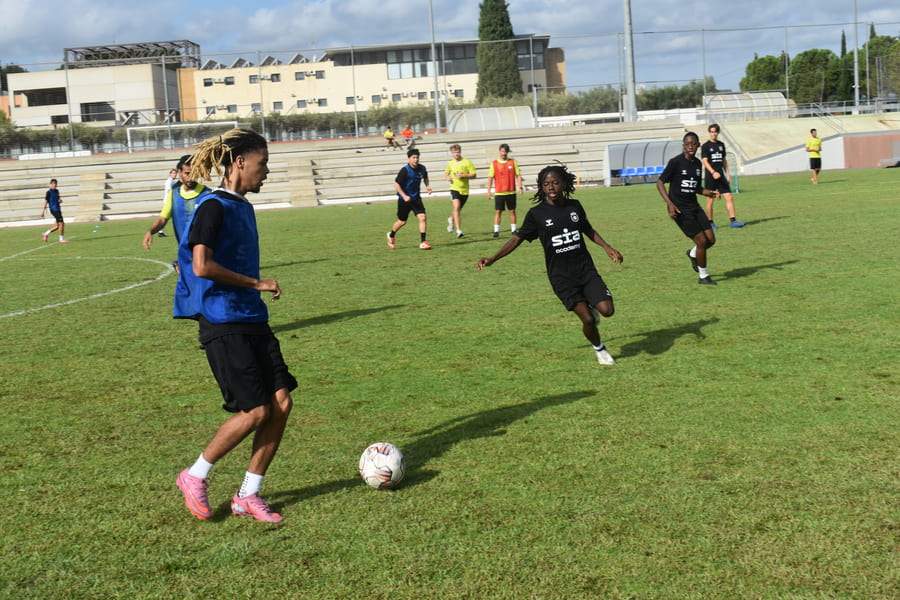

The one-on-one is one of the most decisive moments in football. Whether in defence or attack, these situations condense technique, tactics and psychology into just a few seconds. Understanding what the opponent wants to do before they execute it can make the difference between winning or losing a key action. At SIA Academy we work on this aspect in a specific way, because correctly reading the opponent’s intention is a trainable skill and a fundamental one for modern performance.
Table of contents
The one-on-one as a decision-making scenario
Every individual duel is a constant exchange of information. Body language, speed, foot orientation and distance to the ball all provide clues. Nothing in a one-on-one situation is accidental, and the player who knows how to interpret these signals has a clear advantage. In our methodology we teach footballers to observe before acting, understanding that the opponent’s intention is usually revealed before the final movement.
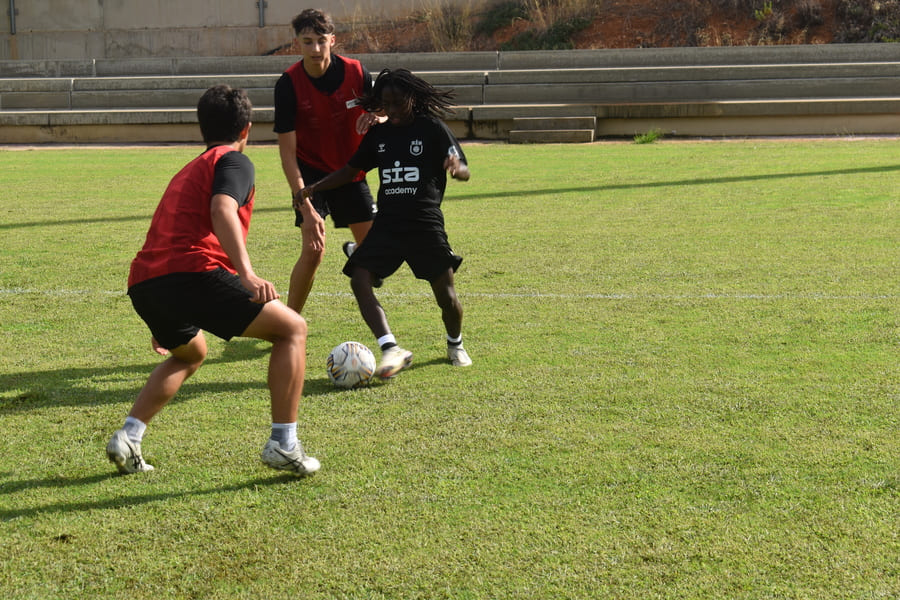
Body posture as the first message
One of the clearest indicators is body posture. The orientation of the hips, the angle of the torso and the position of the shoulders reveal intention long before the dribble or carry takes place. At SIA Academy we train players to identify these details in real time, especially in high-speed contexts where the margin for error is minimal.
Ball control and its relationship with intention
The opponent’s first touch is another key source of information. A long touch, a short one, inside or outside, communicates a specific intention. Learning to read that first contact with the ball allows players to anticipate the next action, whether it is a change of pace, a dribble or ball protection. Alain, a coach at the academy, explains it this way: “The ball speaks, but only players who know how to look can understand it”.
Speed as a misleading element
Many footballers are guided only by the opponent’s speed, but this can be a trap. Going fast does not always mean wanting to beat the defender, and slowing down does not always imply security. Real intention is built by combining rhythm, space and context. At SIA Academy we teach players not to react impulsively, but to interpret the full set of signals before deciding.
Use of space and proximity to support lines
Another determining factor is the available space and the proximity of teammates. The opponent’s intention changes if they have a nearby passing option or if they are isolated, and the defender must read that environment, not just the direct opponent. In our training sessions we always work on one-on-one situations integrated into a collective context, because reading the game is never isolated.
Eye contact and conscious deception
Although it may seem secondary, eye movement also communicates. Some players use their eyes to deceive, others to confirm decisions. Distinguishing when the gaze supports the intention and when it is meant to mislead is an advanced skill, but one that can be trained. Alain often insists on this point: “The intelligent player doesn’t bite on the first gesture, he waits for the action to confirm the intention”.
Anticipating without rushing
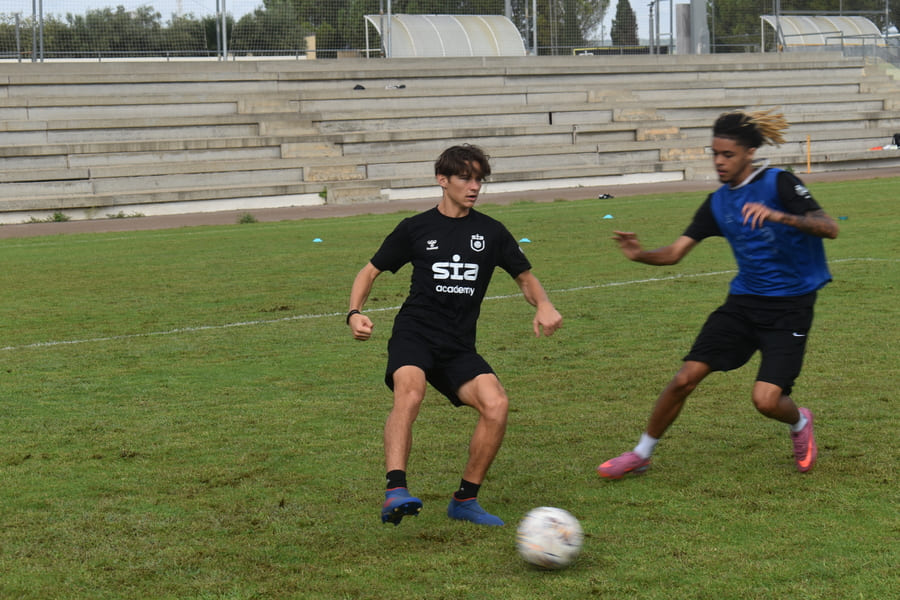
Reading intention does not mean committing too early. Effective anticipation is based on patience and balance, maintaining a distance that allows reaction. At SIA Academy we place great emphasis on the defender’s body control, so they can adjust their response once the opponent’s intention becomes clear.
Mistakes as part of the learning process
Those who take risks will make mistakes, but those who never try do not learn. Misinterpreting intention is part of the process, especially for young players. At our academy we promote an environment where mistakes are a tool for improvement, analysing each situation to refine reading skills in future actions.
Transfer to the real game
All this learning must be transferred to match situations. Reading intention in training only has value if it is applied under real pressure, with fatigue, noise and continuous decision-making. That is why at SIA Academy we design tasks that replicate competitive contexts, where one-on-one situations appear naturally and constantly.
Understanding how the opponent thinks and acts in an individual duel is a huge competitive advantage. Intention is not guessed, it is interpreted, and that interpretation comes from conscious training, observation and guided experience. At SIA Academy we develop players capable of reading the game from within the game, understanding that every gesture from the opponent is an opportunity to anticipate and grow as a footballer.